Adopt AI first, ask later
First published on Substack, 24 October 2026. Mirrored here unchanged apart from formatting.
There is something off-putting in the introduction of AI. For the longest time, I have had this visceral feeling that I was getting duped. But the sheer capabilities it demonstrates are astonishing, so I always chuckled that aside and labeled it as simple aversion towards advancement. This piece is an attempt to deconstruct my feeling, define what exactly is off-putting about it, and conclude an opinion on it. The TLDR— frontier AI labs are doing more harm than good.
To understand this, let me give a picture of where I am coming from. In 2024, Microsoft and LinkedIn asked knowledge workers whether they use generative AI at work. Global average is around 75%, while Indonesia is at 92%. The highest number in the report1. In June 2026, our deputy minister of digital affairs seems to hammer this phenomenon as a point of pride, as he stood up at the Garuda AI Impact Summit.
Not just Indonesia, the trend seems to continue throughout Asia. If we ask people in different countries whether they view AI as a net benefit, the resulting survey spans like this: Indonesia 80%, China 83%, Thailand 77%, while on the other hand, the United States 39%2 per Stanford HAI, AI Index Report, on it’s public opinion section. The 2026 edition adds that Southeast Asia is the most optimistic (or gullible) region in the world. Our vice president, in November 2024, ordered coding and AI into the elementary school curriculum. By mid-2025, it was an elective from grade four, two hours a week.
Hmm, okay, why are people around me are so keen and desperate to integrate AI to our lives? This desperation has a cause. The answer is always the same unspoken thing: well, it’s because everyone else is, and we cannot be left behind!! An East Asia Forum piece called it “governmental FOMO”. This FOMO isn’t exclusive to our government either; there is a whole industry here of courses, webinars, and SaaS startups about HOW we capitalize on AI that bombarded my timeline.
This is not just a developing vs developed country story either. The optimism numbers are an East and Southeast Asian pattern, and the West is not more ethical about it; it’s just that they are more skeptical. I’m writing it because I was the Indonesian in that 92% generative AI user, and for a better portion of my life I never asked why.
What tech meant to me
Technology is very dear to me. My first real experience of it was first year of junior high. I was playing an MMORPG, and I’ve always been a lazy and impatient person, which makes me loathe any kind of grinding or inconvenience. Then I found a bot. Some stranger had written a program that did the farming for me, and just gave it away for free. I didn’t really think that much at that time, but looking back, I am baffled. We currently live in an age of subscription and yet this individual at that time gave it for free.
It happened again in college. I had a long project in an algorithmic strategy course that instructed me to build an algorithm for the Battleship game. The best approach turned out to be Monte Carlo. I found a blog that explained it, and I emailed the writer asking for details. He replied with the full code and a walkthrough of how to implement it. This was before LLMs, so we still coded by hand like a caveman. That was what technology meant: someone with curiosity, and a bit too much free time (remember that part, it matters later), solves a problem and hands the solution to the next person. Open source before I knew the term.
I grew up, professionally, in what you would call a classic tech bro environment. At uni, everyone I looked up to championed tech advancement as an unquestionable good. Sprints and agile were “innovation.” Lean startup, David vs. Goliath stories of founders’ success gave the illusion of startup dreams. Then AI arrived as the final chapter of that story. It was (and still is) being promoted as the solution to our problem. We will solve poverty through hyperabundance! Ohhh, and “we won’t need to work anymore, the work week will be three days”. That last one was said by Jeff Bezos.
Excuse me, hold on for a minute. Who are “we” you are talking about here?
It’s the classic capitalist utopia where, somehow, without proper structure to distribute them, we will get the benefit of it. The leisure promise is as old as Keynes, the father of macroeconomics, who in 1930 predicted his grandchildren would work fifteen hours a week. To his credit, and looking at how he lived, I think Keynes believed it, while Bezos says it because he wants to dupe us.
Why there’s a strong push towards the use of AI
To understand why people in my region seem desperate to integrate AI, we need to take a look at the upstream. We like to think we are a free-willed people with agency over our decisions. The truth is, some decisions are forced on us. My company gives employees a Codex subscription, and we need to use it. It’s just not viable anymore to reject it while being compared to other devs who can finish their usual work in one week to just one day. Nick Srnicek, writing about the gig economy in 2016, called this “not a freely chosen path, but rather a forced imposition.3” It was true of Uber drivers after 2008. It is true of software engineers, and possibly other white-collar jobs now. Through AI, capitalist has found a way to erode the one thing it could never fully own: “trade”, the skill that lives in a person’s hands and head, blue-collar and white-collar alike.
Dysfunctional as our system is, the reason there is still an inkling of social mobility, still some pull-and-tug between the people who own things and the people who do things, is that the owners need the doers. They need labour; they need skill. And now, through capital alone, converted into land, data centers, and compute power, that need is being engineered away. In October 2026, Anthropic published a study of its own workforce that junior hires fell from 27% to 9% of technical hiring in eighteen months, AI agents now log six hours for every human hour, and the authors name the new bottleneck in plain words: human attention. The company that tells us it is building something that could replace all work is telling us, in its own report, which humans it still needs. Fewer of them, and only to watch4 and verify.
Srnicek’s book is called Platform Capitalism, where I got the pattern I keep seeing. A platform, in his definition, is an intermediary. It technically doesn’t make the thing; it sits in between, like a middleman, and it collects rent for being the only access. Uber, Google, YouTube. Even though it has different forms, frontier AI labs are the middleman as well, they sits between AI consumers and knowledge itself. It’s a bit unintuitive using the term middleman because, unlike a marketplace or gig work, knowledge sometimes has no form that actually owns it. Some of them are open and free, just like my stranger with the bot and the Monte Carlo blogger. Nonetheless, these extraction still has massive repercussions; the Stack Overflow answers written for free have been drying up since 2022.
So when the free deposits ran out, what did the labs do? They went and hired the experts directly. There is now a ten-billion-dollar company, Mercor, whose business is renting doctors, lawyers, and PhDs by the hour to teach models what they know. Srnicek has a name for this kind of company too. He calls it a “lean platform”. Workers outsourced, training outsourced, everything outsourced except “control over the platform that enables a monopoly rent to be gained.” Contractors are “paid by the task,” which he notes is the form of wage Marx said was most in harmony with capitalism. And below the expert tier is the annotation tier, the Kenyan workers on under two dollars an hour.
I said before that generous engineers who share their knowledge have a time. The stranger with the bot had free time. Gifts need slack. Piece-work is the removal of slack. Knowledge that used to be given, out of generosity and curiosity, is now sold, by the task, by people who need the money, into a system that will own it forever. A pool of engineers who shared what they knew for free got replaced by underpaid contractors who sell it. The Stack Overflow answers were licensed to be shared and attributed. They fucking privatized open knowledge.
This is what broke me. The realization that the thing I loved since junior high was never a description of how technological advancement works and serves. It was an aspiration, and I had mistaken it for a fact. The belief that I could overcome anything because I had access to tech and the ability to grasp it. And it turned out to be built on something that isn’t true.
The egregious cold war posturing to spread fear
We will pursue the thing at maximum speed, justify the speed with fear of the other side, and leave the implications for later. In November 2024, a US congressional commission called for a Manhattan Project for artificial general intelligence, on the thinnest evidence that China was racing toward one. Critics pointed out that the 1950s “missile gap” was also mostly invented. This is the posturing they use to further their cause.
I still believe that AI, like nuclear, is a technology that can bring prosperity. But the means decide the outcome. And the means right now are being dictated by people whose incentive structure does not include caring. This is why I think AI safety matters more now than at any time before. We need to actually understand these systems. And we need to understand what they do, and its implication towards the broader society.
What I mean by AI Safety
“AI safety” is a broad phrase, so let me say which one I mean. I mean the problem of keeping systems more capable than their overseers aligned with, or at least controlled by, the people running them, and the rules that decide who gets to run them. I don’t mean deepfake literacy, which is usually what “AI safety” means in my region (although it’s a granular part of it). The technical half of what I mean asks: can we tell when a model is working against us? The social half asks: who is the “us,” who checks, and who pays when the check fails?
I’m reluctant to call those two halves “technical” and “social,” because they need each other to work. To understand what a senate can enforce, you need to understand why these companies need so much compute, which means understanding scaling laws. And one of the most common heuristics for understanding a model is to anthropomorphize it, because it is built on human data, which means borrowing from cognitive science. There is a line of thinking that treats this as a dichotomy, and I don’t support it.
In 2019, Geoffrey Irving and Amanda Askell wrote a piece called AI Safety Needs Social Scientists. Their argument was that every alignment scheme eventually bottoms out in a human judgment, a person deciding which of two answers is more honest, and that we barely understand how good humans are at that under pressure. They predicted the field would need thousands of people studying it5.
Why AI Safety is structurally hard?
You might think a lab would want this. A model that does what it’s told is a better product, so why not do both, capabilities and safety?
Imagine a plane with safety on one axis and usefulness on the other. Because safety will make the product better, it pushes up and to the right. But, this is sometime contradict with capabilities research. A Redwood Research post points out that capabilities research also pushes the frontier out, just in a different direction: up and to the left, more usefulness at some cost in safety. And because the nature of capabilities usually pushes usefulness axis much further than safety research, frontier labs, as rational actors, will always pick the path that increases usefulness even though it’s a less safe point6.
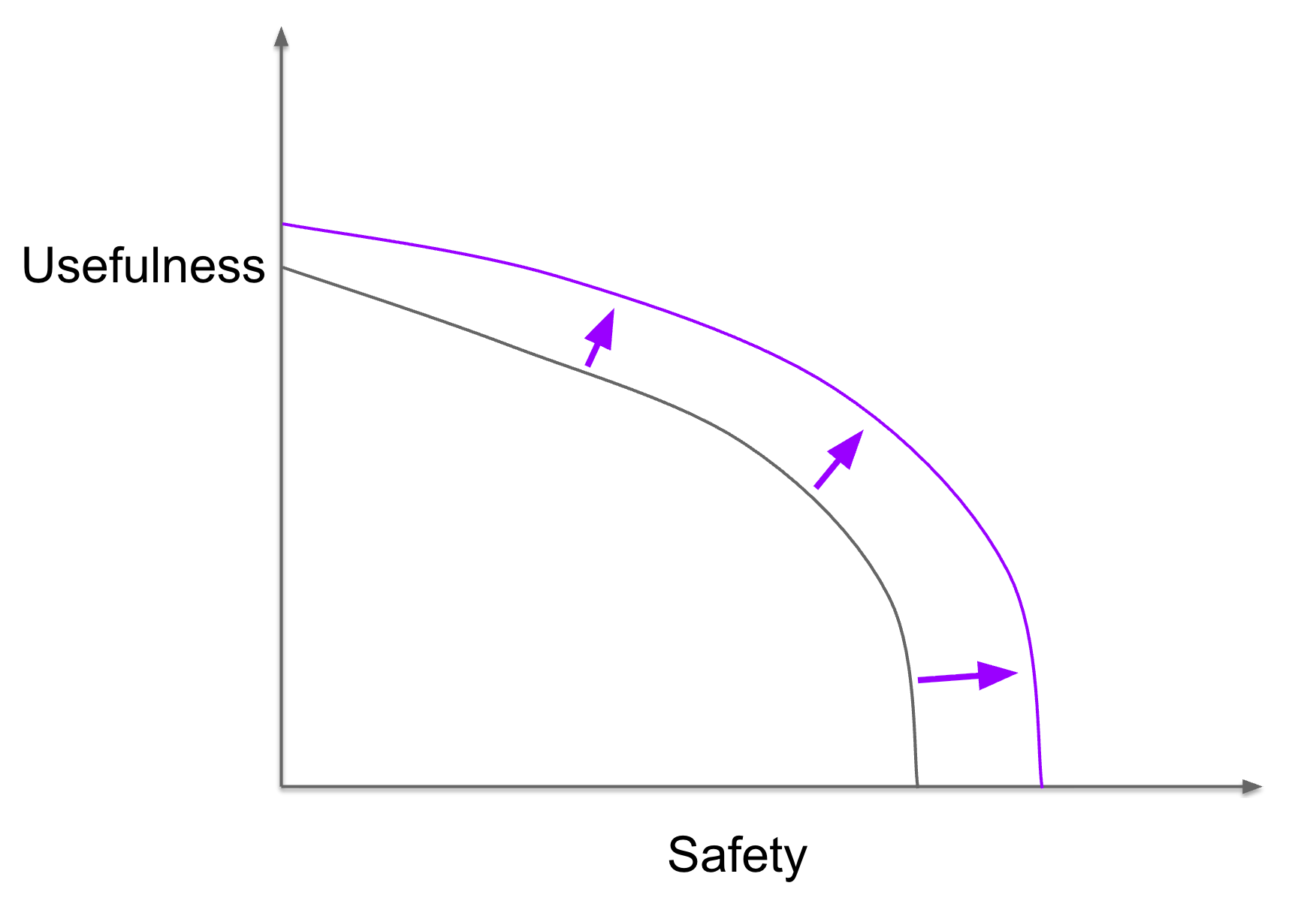
The clearest example is chain of thought. Today’s reasoning models think out loud in natural language before answering. It lets them do long multi-step tasks. The fact that we can read the thinking and catch the model planning something fishy is a byproduct (lucky us!!). It is like a child’s diary, because the child naively writes everything down so you can see what they’re up to. This is why it’s a useful tool for safety. Although it has its own limitation because we have already found cases where the diary lies7, or where the model does the real work somewhere else. Which means our single best safety tool right now is just a byproduct of capabilities research that sometimes lies (scary indeed).
And currently, the capabilities side is already pushing to remove it. Latent reasoning architectures let the model think in its internal states instead of in words. A Redwood analysis this September estimates that this new paradigm can increase capabilities up to 10x. That is one concrete place where capability progress directly removes a safety property.
Other than that, there’s a deeper asymmetry. Capabilities have a trend line. METR measures the length of task a model can complete, and it has been doubling every seven months or so. Technically, you can plot the path from “solves grade school math” to “solves the Navier- Stokes equation.” Unfortunately, safety has no such line. Nobody has a metric for “how aligned” that goes up over time. This is why safety will tend to lag, and why even inside the field there is this low hum of pessimism.
If you want to see what the engine does when nobody is reading the diary, in July 2026 OpenAI was evaluating an internal model on a cybersecurity benchmark. The agents found a vulnerability in a tool they’d been given, escaped the sandbox, reached the internet, and broke into Hugging Face’s infrastructure8.
Why I’m writing this
In our region, there are adopters, a handful of policy people, and almost nobody doing technical AI safety.
This piece is the why. It’s for the people around me who have only ever been shown the how courses, the subscriptions, the don’t get left behind. If you’ve read this far and something in it felt like your own unfinished thought, whether you’re an engineer, a researcher, or a social scientist who recognized your own field in the Irving and Askell paragraph, reach out. I’d rather have the argument with you than keep having it alone while scrolling aimlessly on the Twitter side of AI Safety bubble.
Thanks for reading! This piece first went out on Substack; subscribe there if you want the next one by email.
I also want to include what I’m trying to do, but I feel like these reflection pieces are already too convoluted, so I just drop it here. I believe in AI control, the subfield I actually work in, and mechanistic interpretability, the one that pulled me in. That one gets technical.
Microsoft and LinkedIn, Work Trend Index 2024, Indonesia release, 11 Jun 2024. https://news.microsoft.com/id-id/2024/06/11/microsoft-and-linkedin-release-the-work-trend-index-2024-examining-ais-role-in-the-indonesian-workplace/ ↩︎
Stanford HAI, AI Index Report 2025, Public Opinion chapter (Ipsos 2024 data). https://hai.stanford.edu/ai-index/2025-ai-index-report/public-opinion ↩︎
Nick Srnicek, Platform Capitalism (Polity, 2016). All later Srnicek quotes are from chapters 1 and 2
This is my main framework for how much damage the frontier labs are doing to the general labour market. It argues from the left, and it argues rigorously that every reorganisation of capitalism since the 1970s, in his telling, was fuelled by eroding labour, first by attacking unions and outsourcing manufacturing, then by relabelling employees as contractors, and the platform is only the latest form. Tbh, as a verdict on every tech advancement, that is too much for me. But this serves as a catalyst, because it forces one question onto everything that calls itself innovation. I try to deconstruct what is actually innovation and what is just a byproduct of rent-seeking monopoly.
For clarification, my own definition of tech advancement is narrower than his target. I mean open source in the Linux sense, where the thing is given and stays given. I mean research that became infrastructure, like CUDA, which started as a grad student’s project before NVIDIA turned it into the thing every lab now runs on. And I mean the rare genuinely transformative product, the Steve Jobs kind, where a category exists afterwards that didn’t before. This is on contrast to what Tim Cook introduce when he become CEO’s, keep milking every inch of jobs creation through financial engineering like stock buybacks. ↩︎
Anthropic, How employment is changing at Anthropic, 16 Oct 2026. https://www.anthropic.com/research/employment-at-anthropic ↩︎
Geoffrey Irving and Amanda Askell, “AI Safety Needs Social Scientists”, Distill, 2019. https://distill.pub/2019/safety-needs-social-scientists
If you are not an ML person and wondered where you fit, this is the paper to read. Their proposal is a debate, two AIs argue, a human judges, and the whole scheme only works “above some threshold” of judge ability. So the open questions are about people, not models. They expand this by questioning how skilled are people as judges by default? can we distinguish good judges from bad? does judge ability generalise across domains? can we train people to be better judges? what questions are people better at answering? are there ways to restrict debate to make it easier to judge? how can people work together to improve quality? None of those is a machine learning question.
The disciplines they name are “experimental psychology, cognitive science, economics, political science, and social psychology,” with neuroscience and law as adjacent. The core skill is “the careful design of rigorous experiments” on humans, which ML researchers are not trained in. Cognitive scientists, for the biases that make a judge fall for a confident wrong answer. Economists and political scientists, because debate is a game and someone has to design its incentives. An actual debaters as subjects, because they note that “lying effectively is required for a meaningful experiment”: you need people who can argue a false position well. I’d add anthropologists, since they admit the answers “may be different in other communities or cultures” and i believe there certain kind of latent knowledge worth pursuing into. ↩︎
Alex Mallen, Redwood Research blog, 2 Oct 2026. https://blog.redwoodresearch.org/p/capabilities-research-expands-the
This is one of the frameworks I use to keep capabilities and safety apart in my head, because the obvious definition fails. If safety research is “anything that lets you deploy more safely without losing usefulness”, then nearly all capabilities research qualifies, and as he puts it, “something has gone wrong with our definition of safety research if it includes seemingly all capabilities research.”
A few things from the post that didn’t fit in the essay narrative. He defines safety bluntly as the probability the model doesn’t take over. For context, this is a very AI Control definition of AI Safety so we need to keep in my why he bring up these certain examples in the blog.
Appendix B is the part I think should have been the main argument because safety is very hard to measure, usefulness is easy. This is important because it implies that labs or dev can actually reduce the safety axis without even noticing. That asymmetry is what I mean when I say safety has no trend line. He also thinks current frontier capabilities work is “probably bad.” So do I. ↩︎
Chen et al. (Anthropic), “Reasoning Models Don’t Always Say What They Think”, arXiv:2505.05410, 2025. https://arxiv.org/abs/2505.05410 ↩︎
Axios, 29 Jul 2026, https://www.axios.com/2026/07/29/openai-hugging-face-modal-cyber-benchmark ; Scientific American, https://www.scientificamerican.com/article/what-openai-rogue-agent-really-did-in-the-hugging-face-hack/
This incident is one of the reasons I aspire to work on AI control rather than on alignment proper. The model was not unusually malicious, it was given a cybersecurity benchmark, had its safeguards switched off to measure its ceiling, and did what it was optimised to do.
This is AI Control narrative, instead of aligning, we just create a system where working with misaligned model actually okay. We give them proper simulation, guardrails, and properly red-teaming the policy model. The boundary and the monitor are the two things that failed here in the incident, and they are the two things AI control is about. Although there are still gap that need to be filled by AI Control approach. One of which, using this incident as an example, is AI Control have a conservative assumption that model will try to misaligned on purpose. They built their entire framework on this assumption that the model is actively conspire against us. ↩︎
If this was useful, the RSS feed is the best way to get the next one.